
Quick Answer
Florida voters passed Amendment 3 on November 3, 2026, with about 62 percent of the vote. It raises the non-school homestead exemption to $150,000 in 2027 and $250,000 in 2028, lowers the non-homestead assessment cap from 10 to 5 percent, and leaves school taxes and the 3 percent Save Our Homes cap unchanged.
Amendment 3 at a glance
- Result: about 62 percent yes, above the 60 percent needed. The count is unofficial until certified.
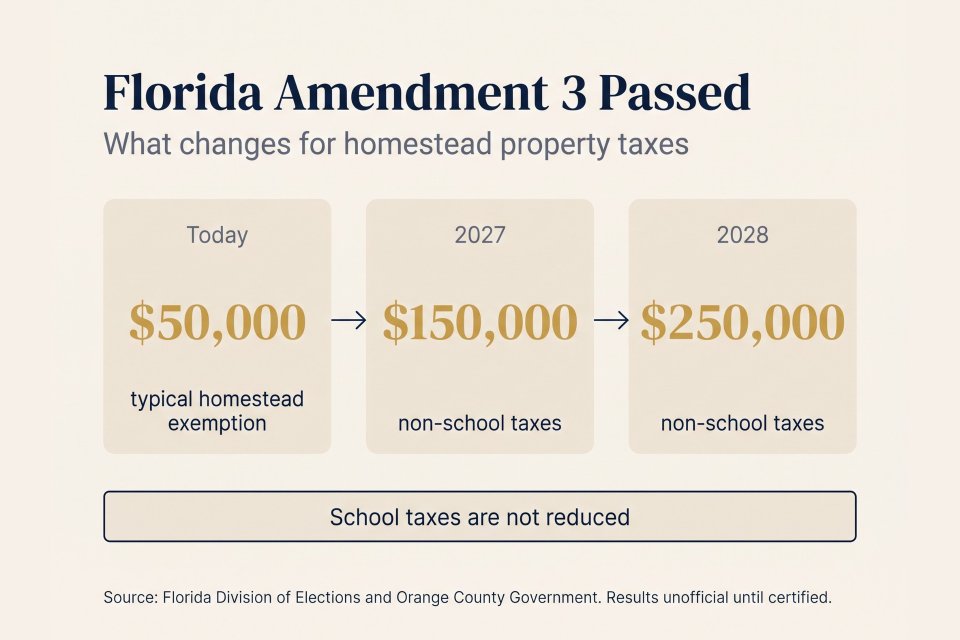
- Bigger exemption: $150,000 in 2027 and $250,000 in 2028 for non-school property taxes, with inflation adjustments after that.
- School taxes: not reduced. The first $25,000 exemption still applies to school taxes, and the larger one does not.
- Rentals and second homes: the yearly assessment cap for non-homestead property drops from 10 percent to 5 percent.
- New residents: if you were not a Florida resident on December 31, 2026, you get the current exemption first and the larger one starting in your fifth year.
- Not changed: the 3 percent Save Our Homes cap.
- Still open: how local governments will respond, since counties warn of lost revenue.
Did Amendment 3 pass, and what did voters approve?
Yes. Florida voters approved Amendment 3 on November 3, 2026, with about 62 percent of the vote, above the 60 percent the Constitution requires. News outlets reported the result on November 4, and the count is unofficial until the state certifies it. Two other amendments on the same ballot, Amendments 1 and 2, did not reach 60 percent.
Amendment 3 changes the homestead exemption, which is the reduction in taxable value that Florida gives owners on a primary residence. The measure does not set your tax bill. It changes how much of your home's value is taxed, and your local tax rates still decide the rest.
What does the bigger homestead exemption change?
 The non-school part of the homestead exemption rises to $150,000 in 2027 and $250,000 in 2028, with inflation adjustments after that, according to the county and news summaries of the amendment. Today the typical homestead exemption is about $50,000 in total.
Here is the part that is easy to miss. School district taxes are not reduced. The first $25,000 of the exemption still applies to school taxes, and the larger exemption does not. For many homeowners, school taxes are a large part of the bill, so the drop will be more modest than the headline numbers suggest. The best way to see your own number is the property appraiser's tax estimator for your county, which the property taxes and homestead page links to for Orange, Lake, Osceola, Polk, and Seminole counties.
What does it change for second homes, rentals, and new residents?
Three other parts of the amendment matter to buyers. First, the yearly assessment cap on non-homestead property, such as second homes and rentals, drops from 10 percent to 5 percent. That limits how fast the taxable value of those properties can rise each year.
Second, there is a residency rule. If you were not a Florida resident on December 31, 2026, you receive the current exemption first and the larger exemption starting in the fifth year you hold homestead. If you are moving to Florida now, plan your budget around the current exemption for your first years.
Third, the 3 percent Save Our Homes cap on yearly increases in your assessed value on a homestead is unchanged. A home you buy still resets to its purchase price in the first year, which is why a seller's current tax bill does not predict yours.
What are local governments saying?
Counties and cities fund services such as fire and sheriff from property taxes, and they have warned about lost revenue. Orange County estimates its property tax revenue would fall by about $165 million in 2027 and $275 million in 2028. The county says no decisions have been made about service changes, and that leaders would need to look at spending reductions, fees, and other legal revenue options. Those county numbers are estimates, and the Legislature and local governments still have to decide how the change is carried out.
For a buyer, that means two things can be true at once. Your homestead exemption may be larger starting in 2027, and local tax rates, fees, and special assessments can still change. Ask about all of them, not only the exemption.
What should buyers do now?
 Run the estimate for the exact address, not for the listing's tax figure. A listing often shows the seller's current tax bill, which includes their exemption and their capped value. Your bill will be based on your purchase price, the local millage rates, and the exemptions you qualify for. Apply for homestead on a home you will live in as your primary residence, with the deadline set by your county property appraiser.
Start with the Winter Garden area guide, then walk through the steps in the buyers guide. For contract questions, the As Is Contract guide and the inspection period guide explain the deadlines in a Florida purchase. For schools, use the approach on the schools page and check zoning for each exact address.
This is general education about property taxes, not tax or legal advice. For your own situation, check with your county property appraiser or a tax professional.
Message me if you want help estimating the taxes on a specific home before you make an offer.
Frequently asked questions
Did Florida Amendment 3 pass?
Yes. Voters approved Amendment 3 on November 3, 2026, with about 62 percent of the vote, above the 60 percent needed. The count is unofficial until the state certifies it.
How much is the new homestead exemption?
The non-school part of the exemption rises to $150,000 in 2027 and $250,000 in 2028, with inflation adjustments after that. School taxes are not reduced, and the first $25,000 exemption still applies to school taxes.
Will my property taxes drop in 2027?
They may for a homestead property, but the amount depends on your local tax rates, your home's value, and how much of your bill is school tax. Use your county property appraiser's tax estimator for the exact address.
Does the larger exemption apply if I am moving to Florida?
If you were not a Florida resident on December 31, 2026, you receive the current exemption first, and the larger exemption starts in the fifth year you hold homestead.
Does Amendment 3 change the 3 percent Save Our Homes cap?
No. The 3 percent cap on yearly increases in assessed value for a homestead is unchanged. The assessment cap for non-homestead property, such as rentals and second homes, drops from 10 percent to 5 percent.
Sources: Orange County government (Property Tax Amendment 3 page), Spectrum News 13 (November 4, 2026), NBC 6 Miami, BayNews 9, and the mikevein.com property taxes and homestead page. Results are unofficial until certified, and implementing details are still to come from the Legislature and local governments. Compiled November 4, 2026.
Mike Vein | Orlando | REALTOR
eXp Realty
(407) 612-2722
Realty@MikeVein.com
Mike Vein, REALTOR® | eXp Realty | Florida license SL3610199
FROM OUR BLOG

Ovation Orlando: What Accesso Is Building Near Disney, and What the Delta Hotel News Means
Quick Answer Accesso plans to break ground on Ovation Orlando in the first half of 2027, with all three districts expected to open in 2028. The project would replace the abandoned Orlando Sun Resort site at Interstate 4 and US 192 with dining, retail, entertainment, and three hotels. No tenants are
Avalon Road Agricultural Enclave Hearing: What to Know Before Nov. 10
Quick Answer Orange County commissioners are scheduled to hold a public hearing on November 10, 2026, on whether to certify the property at 5477 Avalon Road as an Agricultural Enclave under Florida Senate Bill 686. Certification would not approve a subdivision or authorize construction, but state la
What Parts of an Offer Are Negotiable in Florida? Almost All of Them
Quick Answer In Florida, almost everything in an offer is negotiable except the printed wording of the contract form. Price, deposit, closing date, financing terms, inspection period, title and survey costs, seller credits, included items, possession date and riders are all on the table. Form defaul